ListenPick a chapter, then press Play. Your device reads it aloud.
DLUXU PRESENTS
THE TRUMP METHOD FOR REAL ESTATE
How Presales, Promissory Notes, and Pre-Sold Space Turn a Vision Into a Bank Loan
Sell the future first. Prove the demand on paper. Then let the bank fund the gap.
BY DLUXU • FOR DEANDRA
An educational playbook on the development financing sequence made famous by Donald J. Trump — and how a smaller developer can run the same sequence, carefully and legally.
Do not ask a bank to believe in your building. Show the bank a building that buyers, tenants, advertisers, and investors have already committed to on paper — then ask the bank to fund the difference between what is already sold and what it costs to build.
FRONT MATTER
Read this first
This book explains a financing method. It is not legal advice, tax advice, or financial advice, and it is not an offer to sell securities or real estate. Promissory notes, investment contracts, condo presales, and commercial leases are all regulated. Laws differ by state and by country, and they change. Before you take a deposit, sign a note, or promise a return to anyone, hire a licensed real estate attorney and a certified public accountant in the state where the project sits. The cost of that advice is small compared with the cost of unwinding a bad note.
Names and projects in this book — including Trump Tower and the Grand Hyatt in New York — are used to illustrate a widely reported development pattern: control a site, pre-sell space, and use those commitments to support construction financing. Figures that vary by source are described in general terms rather than as audited numbers. Where this book gives a threshold, a percentage, or a timeline, treat it as a starting point for a conversation with your lender, not as a guarantee that any lender will agree to it.
THE METHOD IN ONE SENTENCE
Do not ask a bank to believe in your building. Show the bank a building that buyers, tenants, advertisers, and investors have already committed to on paper — then ask the bank to fund the difference between what is already sold and what it costs to build.
How to use this book: Read the Introduction and Chapters 1–5 for the full sequence. Use Chapters 6–8 to grow it. Read Chapter 9 before you sign anything. Keep Chapter 10 and the Appendices open while you work on a real project.
INTRODUCTION
The building is sold before it is built
Most first-time developers work in this order: find land, buy it, design a building, borrow money, build it, and then hope someone wants it. Every step spends money before a single dollar of demand is proven. If the market turns while the building is going up, the developer is left holding the most expensive object in the neighborhood and a loan that still has to be paid.
The method in this book reverses that order. First you control a site — you do not have to own it outright. Then you design something specific enough that people can picture themselves in it. Then, before the building exists, you sell the future: apartments or condos are reserved and pre-purchased, shops and offices are pre-leased, advertising and naming space is pre-sold, and investors put in early money. Those commitments are put on paper — purchase agreements, leases, advertising contracts, and, where an attorney structures it, promissory notes. Finally you carry that paper to a bank. You are not asking the bank to gamble on an idea. You are showing the bank a project that is already partly sold and asking it to lend against that proven demand.
That is the heart of what Donald Trump did, at enormous scale, in New York in the late 1970s and 1980s, and what developers large and small still do today under plainer names: presales, pre-leasing, anchor tenants, and construction lending against contracted revenue. The branding was loud. The financing underneath it was disciplined in one specific way — other people's commitments came first, and the bank's money came after them.
Why banks like paper more than renderings
A rendering shows what a building could look like. A signed purchase agreement with a deposit in escrow shows that a real person valued that future space enough to risk money on it. A signed lease from a creditworthy shop or office tenant shows future rent the bank can count. An advertising or naming contract shows a second income stream that does not depend on selling a single unit. Stack enough of that paper together and the bank's question changes. It is no longer "Will anyone want this?" It becomes "Is what is already sold enough to protect our loan if some of it falls away?" That is a question a bank can answer — and a loan it can approve.
This book walks through the whole sequence in the order you would actually do it, names the paper at each step and what it can and cannot do, shows you how to package that paper for a lender, and ends with the risks. The risks matter. The same leverage that makes this method powerful is what magnified Trump's well-documented debt crisis in the early 1990s, when property values fell and loans came due faster than buildings could be sold. The method is a tool. Used with real demand, honest paper, and reserves, it builds buildings that could not otherwise be built. Used with inflated promises, it builds lawsuits.
A NOTE ON SCALE
You do not need a Fifth Avenue tower to use this sequence. A four-unit building, a small mixed-use block, a co-living building with shops on the ground floor, or a conversion of an existing building can all be pre-sold, pre-leased, and financed in the same order — smaller numbers, same logic.
CHAPTER 1
Control the land without owning it outright
The first move is not buying. It is control. If you buy a site outright on day one, your money is trapped in dirt while you spend a year or more on design, permits, and presales — and interest, taxes, and insurance run the whole time. Developers who use this method instead secure the right to buy, on terms that give them time to prove demand first.
The tools of control
Option to purchase — You pay a relatively small fee for the exclusive right to buy the site at an agreed price within an agreed period. If presales succeed, you exercise the option. If they fail, you lose the fee, not the full price of the land.
Contingent contract — You sign a purchase contract but make closing depend on things that must happen first: zoning or permits, financing, or a minimum level of presales. The conditions are written into the contract by your attorney.
Landowner as partner — The landowner contributes the land as their share of the project and takes a share of the profit or a later payment instead of cash today. This was a recurring pattern in large New York deals, where land, air rights, and tax arrangements were negotiated as part of the project rather than bought for cash alone.
Phased closing — A smaller project can be split so the most sellable part is built and sold first, and its proceeds help carry the rest. Chapter 6 covers phasing in full.
Air rights deserve a special mention in dense cities: the right to build upward over a neighboring property can be bought or negotiated separately from the land itself. Trump Tower famously involved the air rights over the neighboring Tiffany & Co. building. Most readers will never negotiate Manhattan air rights, but the principle travels — look for value around the site, not only in it: parking rights, easements, tax abatements, and historic or development incentives offered by your city or county.
What to lock down before you sell anything
A site you control in writing, with enough time — presales take longer than you expect.
A realistic check on zoning: what can legally be built, how tall, how many units, and what parking is required.
A rough cost from a contractor or cost estimator, not a guess. Your presale prices must survive contact with real construction costs.
A preliminary conversation with a lender about what presale level they would want to see. Ask early. Their answer shapes your whole sales target.
DO NOT SKIP THIS
Never take deposits or sell units in a building you do not control, or that zoning does not allow. Enthusiasm is not a defense. Control first, paper second, sales third.
CHAPTER 2
Create four kinds of pre-sold value
A mixed-use building is not one product. It is several products stacked in the same structure, each sold to a different buyer, on a different kind of paper, at a different time. Trump's signature projects made this visible — Trump Tower combined luxury condos above, offices in the middle, and high-end retail at street level, wrapped in a marble atrium that itself became an attraction. Each layer made the others more valuable. You can use the same stacking logic at any scale.
Bucket one: residential units, pre-purchased
Buyers sign a purchase agreement for a unit that does not yet exist and pay a deposit, held in escrow under the rules of your state. Deposits are commonly structured in stages — a portion at signing, a portion at a construction milestone, and the balance at closing — but the exact structure, the buyer's right to cancel, and the disclosures you must give are set by state law, and for condos, often by specific condominium and interstate land sales rules. Your attorney drafts this. A strong presale list, with real deposits from qualified buyers, is the single most persuasive thing a residential developer can show a construction lender.
Bucket two: commercial space, pre-leased
Shops, restaurants, offices, clinics, salons, and service businesses sign leases — or, earlier, letters of intent that later become leases — for space in the finished building. One well-known anchor tenant can do more for a loan application than ten unknown ones, because the bank can evaluate that tenant's credit and count the contracted rent. In a co-living or live-work building, the ground-floor shops are not an afterthought: they are income that continues even in a slow housing market, and they make the homes above them more desirable.
Bucket three: advertising and commercial rights, pre-sold
This is the bucket most small developers forget. A building with foot traffic owns attention, and attention can be sold in advance: naming rights for the building or its courtyard, signage on the facade, sponsorship of the pool, atrium, or event space, advertising panels in high-traffic areas, and preferred-vendor or exclusive-provider deals — for example, one coffee shop, one gym operator, or one internet provider for the whole building. Businesses will sign contracts and, in some structures, pay deposits for these rights before opening day, because they are buying a location in a place that is already being marketed. Every such contract is another line of contracted revenue in the bank packet.
Bucket four: investor money, committed early
Investors can enter in several ways: buying an equity share in the project company, buying a unit as an investment, or lending money to the project under a properly drafted promissory note (Chapter 3 explains what that note is and why it must be handled by an attorney). Early investor money does three jobs at once. It pays for design, permits, and marketing — the pre-construction costs a bank usually will not fund. It shows the bank that people with money have already examined the project and committed. And it becomes part of the equity the bank wants to see alongside its loan.
The four buckets of pre-sold value
Bucket
Buyer
Paper
What the bank sees
Residential units
Homebuyers
Purchase agreement + escrowed deposit
Proven sales value
Commercial space
Shops, offices, services
LOI, then lease
Contracted rent
Advertising / naming
Local & national brands
Sponsorship / signage contract
Extra income stream
Investor capital
Private investors
Equity docs / promissory note*
Equity cushion + belief
* Promissory notes and equity offerings are regulated. See Chapter 3 and Chapter 9. Nothing in this table is a template for a legal document.
THE STACKING EFFECT
Each bucket raises the value of the others. Homes sell for more above good shops. Shops pay more rent in a building full of residents. Advertisers pay more where residents and shoppers mix. Sell the stack, not just the units.
CHAPTER 3
Paper that proves demand: LOIs, purchase agreements, and promissory notes
Put plainly, the method is this: get people to invest, get people to pre-purchase units or advertising or commercial space, put those commitments on paper, and take that paper to get a bank loan. Paper is what turns interest into something a bank can count. But the three kinds of paper below are not interchangeable, and using the wrong one, or using the right one carelessly, is where small developers get into legal trouble. Learn the differences cold.
Letter of intent (LOI) — interest, written down
An LOI says, in plain terms: we intend to lease this space, sponsor this wall, or buy this unit, on roughly these terms, if the final contract matches. Most LOIs are explicitly non-binding except for a few clauses such as confidentiality or exclusivity. An LOI is useful early — it lets you test prices and fill a tenant mix on paper — and a bank will glance at a stack of them. But a bank will not lend against LOIs alone, because the signer can usually walk away. Treat LOIs as the first rung, and convert the serious ones upward.
Purchase agreement and lease — commitment, written down
A purchase agreement for a pre-construction unit and a commercial lease are binding contracts. They name the parties, the space, the price or rent, the deposit or security, the timeline, and what happens if either side defaults. Money moves with them, into escrow where the law requires it. This is the paper that carries weight. When this book says "presales," it means this level of paper — not handshakes, not a waiting list, not social media followers.
Promissory note — a promise to pay, written down
A promissory note is a written, signed promise by one party (the maker) to pay a stated sum of money to another party, either on demand or at a stated future date, sometimes with interest. In real estate, notes show up in several legitimate places:
An investor lends money to the project company and receives a note stating the amount, interest, maturity date, and what happens on default — and whether the note is secured by property or unsecured.
A buyer or commercial tenant may sign a note for a deferred portion of a price or fit-out cost, under a contract drafted by an attorney.
A seller of land may take back a note instead of full cash at closing, becoming the project's first lender (seller financing).
Here is the critical warning, and it is not fine print. When you offer promissory notes to investors — especially to several investors, especially with a promised return, and especially to people who are not wealthy or experienced — securities law may treat those notes as securities. Selling securities without registering them or fitting within an exemption can bring regulators, rescission claims (investors demanding their money back), and personal liability. Condo presales carry their own disclosure and escrow rules. This is not a do-it-yourself area. The method works with an attorney structuring the paper from the start; it fails expensively without one.
The paper, compared
Paper
Binding?
Money moves?
Weight with a bank
Letter of intent
Usually no
Usually no
Low — shows interest
Purchase agreement
Yes
Deposit to escrow
High — proven sale
Commercial lease
Yes
Deposit / first rent
High — contracted rent
Promissory note
Yes
Loan proceeds
Varies — depends on maker & security*
Advertising contract
Yes
Deposit / staged fees
Medium — extra income
* A note is only as strong as the person or property behind it. A bank will discount or ignore notes from makers it cannot verify.
Rules for paper that holds up
Use real names, real identification, and verified funds. A presale to a buyer who cannot close is worse than no presale, because the bank will find it in diligence.
Put deposits in a proper escrow account, handled exactly as your state requires. Never spend escrowed deposits on construction unless the law and the contract clearly allow it.
Write the exit honestly. Every document should state, in plain language, what happens if the project is delayed, changed, or cancelled, and how money is returned.
Keep a clean presale ledger: unit, buyer, price, deposit received, date, and status. This ledger becomes a core page of the bank packet in the next chapter.
Never promise a return you cannot guarantee — because you cannot guarantee one. Market the property and the plan; let the documents state the actual terms.
CHAPTER 4
Package the commitments so a bank can underwrite them
Banks do not approve projects. Loan committees approve packets. By the time you sit down with a lender, your job is to have assembled the packet so completely that the committee's questions are answered before they are asked. Think of the packet as the building, on paper, in the order a banker reads.
The presale packet, in order
Executive summary — One page: what is being built, where, how many units and how much commercial space, total cost, amount requested, and how much is already sold or leased.
The site — Zoning confirmation, permits status, and the site-control document from Chapter 1.
The sales — The presale ledger (Chapter 3), copies of signed purchase agreements, and an escrow statement showing deposits actually received.
The leases — LOIs and signed leases, with a tenant list that flags any anchor tenant and its credit standing.
The extra income — Naming, signage, sponsorship, and advertising contracts, with payment schedules.
The investors — Investor commitments, equity already in, and any notes — fully documented, with your attorney's structure memo.
The numbers — A line-by-line budget (land, hard construction costs, soft costs such as design and permits, financing costs, and a contingency reserve) and a pro forma showing projected income, expenses, and debt service, year by year.
The team — Who you are, what you have built or managed before, who your contractor and architect are, and references. First-time developers borrow credibility from an experienced team.
The numbers a lender will test
Exact requirements vary by lender and market, but every construction lender is testing the same handful of relationships. Know them before the meeting, and know your project's answer to each:
Loan-to-value (LTV) — What the finished project is expected to be worth versus what the loan is. Lower is safer for the bank.
Loan-to-cost (LTC) — Total project cost versus the loan. Banks expect the developer and investors to fund a meaningful share first or alongside.
Presale threshold — Many residential construction lenders want to see a substantial share of units pre-sold to qualified buyers before funding, or before funding beyond a certain stage. Ask your lender for their number early and build your sales plan around it.
Debt service coverage — For income-producing space, projected rent divided by projected loan payments. The bank wants income comfortably above payments, not equal to them.
Contingency — A budget line for the unexpected. A packet with no contingency reads as naive, not optimistic.
HONESTY IS A STRATEGY
Loan officers talk to each other, and appraisers verify. An inflated presale price or a friendly "buyer" who is not real will surface in diligence and kill not just this loan but your reputation with every lender who hears about it. The method's power comes from real demand. Fake demand is fraud, and it is also bad business — you still have to build the building.
CHAPTER 5
The loan conversation, step by step
Picture the meeting the way this method intends it. You do not open with the dream. You open with the sold portion. "Here is the site, which we control. Here are the units already under contract, with deposits in escrow. Here are the shops already leased, including our anchor. Here is the advertising and naming income already signed. Here is the investor equity already committed. The project costs this much. What is already sold and committed covers this much. We are asking you to lend the gap, secured by the project, and here is how the loan gets repaid even if sales slow down." That ordering is the whole method in one paragraph.
The sequence, from first coffee to funded loan
Sound out two or three lenders early. Months before you need the loan, ask what they require: presale threshold, equity share, appraisals, and who must guarantee what. Build to their checklist.
Run presales and leasing until you can beat the threshold, not just meet it. Never depend on one bank. A second lender's questions will improve your packet for the first.
Present the packet, not a pitch deck alone. Bring the packet from Chapter 4, printed and digital, and leave it behind. Committees decide after you leave the room; the packet is your voice in that room.
Survive diligence. Expect an appraisal, a review of every presale buyer, and questions about your contingency and your exit. Answer with documents, not adjectives.
Understand the draw and the exit before you sign. Construction loans are usually drawn in stages as work is verified, carry interest during construction, and must be repaid or converted at completion — by unit closings, by a permanent loan on the rented portion, or both. Your presale closings are not just profit; they are the loan's repayment plan.
If the bank says no
A no from one lender is market research. Ask exactly which test the project failed — presales too low, equity too thin, appraisal too low, team too green — and fix that specific thing. Common fixes inside this method: pre-lease one more anchor tenant, sell the naming or advertising rights you were holding back, bring in a co-developer or contractor with a track record, phase the project smaller (next chapter), or add seller financing from the landowner so the bank's share shrinks. What you must not do is shop the same weak packet to every bank in town and burn your name with all of them at once.
THE GUARANTEE QUESTION
Small developers are often asked for a personal guarantee on a construction loan. That means your own assets stand behind the project. Understand exactly what you are signing, cap it if you can negotiate a cap, and never let a partner sign one on the group's behalf without written agreement. Your attorney and accountant earn their fees right here.
CHAPTER 6
Build in phases so early money proves the next phase
Phasing is the safety valve of the whole method. Instead of borrowing for the entire vision at once, you divide the project into stages, each of which can be pre-sold, financed, built, and occupied on its own. Phase one's real closings and real rent replace projections in the packet for phase two — and a bank lends far more easily against a photograph of a finished, occupied building than against a rendering of one.
A live-work, co-living building phases naturally. Phase one might be the ground-floor shops and the first stack of homes, with the courtyard open so the place feels alive. Phase two adds the remaining homes and the pool or amenity level once the shops are trading and the first residents have moved in. Each phase gets its own presale push, its own advertising sales — a sponsor would rather buy into a courtyard people already use — and its own, smaller loan. If the market cools after phase one, you own a finished, income-producing building instead of half of a giant one.
Rules for clean phases
Every phase must stand on its own legally and physically: its own permits, access, utilities, and fire exits, with no dependence on a later phase to function.
Tell phase-one buyers exactly what later phases are planned. Surprises create lawsuits; disclosed plans create anticipation.
Keep the design language constant across phases so early buyers are not left in a building that looks unfinished by comparison.
Use phase-one results honestly. If phase one sold slowly, that is information: change the price, the mix, or the size before borrowing for phase two.
CHAPTER 7
Sell the vision: branding, model spaces, and press
In most businesses, marketing promotes something that exists. In this method, marketing creates the asset the loan is based on — presales. That makes the sales operation a financing function, not a cosmetic one, and it deserves the same seriousness as the budget. Trump's career is the extreme case study: a surname placed on buildings in gold letters, atriums designed to be photographed, openings staged as news events, and a consistent story — luxury, success, arrival — told before, during, and after construction. You can run a quieter version of the same playbook without the gold letters.
What actually sells an unbuilt building
Something to walk through — A furnished model unit or model shop, or the highest-quality walk-through rendering you can afford, so buyers can stand inside the future.
A price list with nothing hidden — Floor plans, finishes, prices, deposit schedule, completion estimate, and the legal disclosures — all public, all consistent. Confidence comes from specifics.
Events that mark real progress — Groundbreaking, topping-out, anchor-tenant signing, and model opening are each a reason for local press, a launch event, and a fresh round of advertising sales.
A story about living there, not just owning there — The ground-floor tenant mix, the courtyard, the pool — the life of the place — is often what sells the homes above it.
One discipline protects all of it: advertise only what the documents support. Completion dates are estimates and should be labeled as such. Amenities that depend on a later phase should be described that way. In most states, real estate advertising and condo marketing are regulated, and a disappointed buyer's first exhibit is your brochure. Let your attorney review the sales materials once. It is cheaper than the alternative.
CHAPTER 8
License the name, keep the upside, limit the ownership
Later in his career, Trump expanded a second model alongside building: licensing. Other developers built and owned the buildings; the Trump name, standards, and marketing went on them for a fee, and management contracts could follow. The developer carrying the debt was someone else. Whatever one thinks of the brand, the financial structure is instructive: a name that helps sell units is itself an asset, and it can be rented.
At a small scale, the same structure appears whenever a known local brand — a respected restaurant, a beloved gym, a trusted developer's own name — anchors a project it does not own. Two lessons transfer. First, if you build one successful project under your name, that name becomes presale power for the next one; protect it, and never put it on a project you do not control. Second, when a stronger brand offers to license to you, read the fee, the term, the quality controls, and the exit clause with the same care as a loan document — a licensing fee is a cost the pro forma must carry in good years and bad.
BUILD THE NAME SLOWLY
Licensing only works when the name already means something to buyers. For a first project, borrow credibility instead: an experienced contractor, a known anchor tenant, and a respected local architect lend their reputations to your packet without a licensing fee.
CHAPTER 9
Where the method breaks: risks and legal traps
Every strength in the preceding chapters has a shadow side, and an honest book about this method has to spend a full chapter on it — because the method's most famous practitioner also produced its most famous warning. In the early 1990s, falling property values, heavy debt, and the costs of the Atlantic City casino expansion forced a series of restructurings in which lenders took losses, assets were sold, and Trump came close to personal financial collapse before recovering. The lesson is not that leverage is evil. The lesson is that leverage assumes the future arrives on schedule, and sometimes it does not.
The five failure modes
Presales that evaporate — Buyers cancel, fail to qualify, or cannot close when rates rise. Protect yourself with staged deposits the law allows, a waitlist of backup buyers, and a sales pace that does not depend on every single contract closing.
Paper mistaken for cash — A note is worth the maker's ability to pay. Unverified investor notes, or presale contracts from unqualified buyers, inflate the packet and deflate in diligence — or worse, after the loan funds.
Securities and presale law — Offering notes or equity to the public without a registration or a valid exemption, mishandling escrowed deposits, or marketing units with unapproved materials can each independently stop a project. None of these is a technicality.
Cost overruns with a drawn loan — Construction costs rise and schedules slip. Fixed-price contracts where possible, a real contingency, and phased borrowing limit the blast radius.
A building that cannot be governed — Leased shops and sold homes in one building create a community with legal rights — condo associations, commercial tenants, and advertisers whose contracts survive your sale of the building. Structure the ownership (condo, rental, or mixed) with an attorney before the first sale, not after.
There is also a human trap worth naming: the method rewards confidence, and confidence is habit-forming. The developer who pre-sold one building successfully is tempted to pre-sell three at once. Scale the sequence one proven project at a time, keep personal guarantees rare and capped, and hold a cash reserve outside the project. The developers who survive a downturn are the ones who can wait.
THE RED-FLAG LIST — STOP AND GET ADVICE IF
someone proposes taking deposits outside escrow; an investor is promised a guaranteed return; a note is offered to the general public; a lender is shown numbers you would not show your own family; or a partner resists putting any of it in writing. Each of these converts the method from financing into fraud risk.
CHAPTER 10
Your playbook: applying the method to your own project
Here is the whole book as a working sequence. It assumes a small mixed-use project — homes with shops or services at ground level — but the order adapts to a pure residential building, a small office or retail block, or a conversion.
The sequence, on one page
Control. With your attorney: entity, site option or contingent contract, zoning check.
Design to a price. Architect's concept, contractor's rough budget, and a design specific enough to sell from.
Test the bank early. Ask two lenders what presale and equity levels they require. Write the answers down.
Pre-sell all four buckets. Open the four buckets: unit presales, commercial LOIs converting to leases, advertising and naming offers, and attorney-structured investor commitments.
Build the packet. Assemble the Chapter 4 packet with a clean presale ledger and escrow proof.
Borrow the gap. Present sold-first, borrow the gap, and confirm the draw schedule and the repayment exit before signing.
Build, close, repeat. Build phase one, close its sales, collect its rent — then repeat the packet with real numbers for phase two.
A 90-day starter plan
Days
Focus
Done when
1–30
Site control, zoning, team
Signed option + zoning letter
31–60
Design, budget, lender soundings
Rough budget + 2 lender checklists
61–90
Presale launch prep
Sales packet + attorney-reviewed docs
Days 61–90 end at launch readiness, not at launch. You open sales when the documents, the escrow account, and the disclosures are ready — not when enthusiasm peaks. From launch, the presale ledger becomes your weekly dashboard: contracts signed, deposits in escrow, leases converted, advertising sold, and the distance remaining to your lender's threshold.
A worked miniature
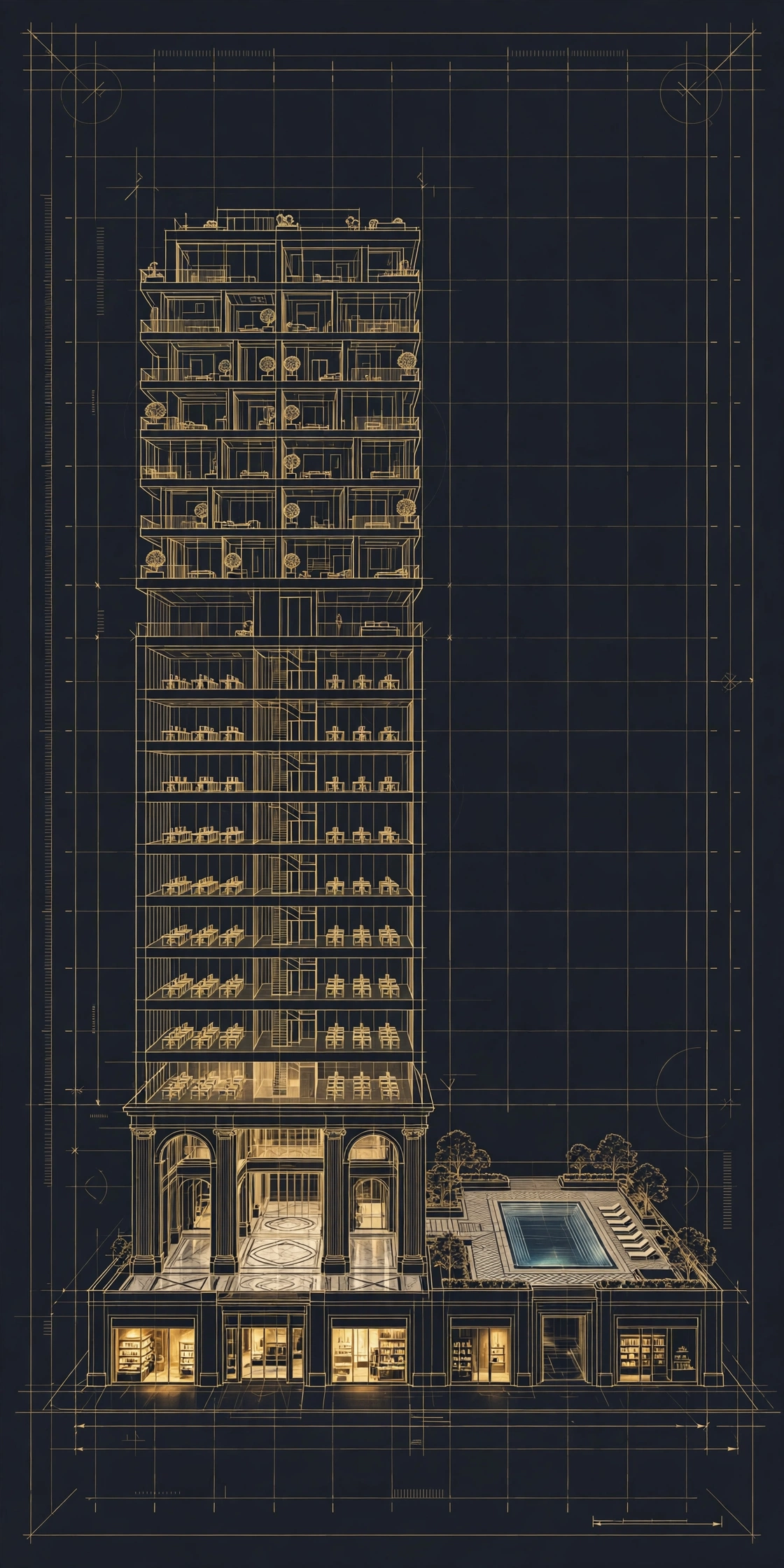
Imagine a two-storey live-work building: eight homes above four ground-floor shops, around a small courtyard with a pool. You control the site with a nine-month option. The shops are offered first, because one signed anchor — say, a café — makes the homes easier to sell and the courtyard sponsorship worth buying. Homes are then pre-sold from a model corner unit built as a sales center. The courtyard naming and two signage positions are packaged for local businesses that want to be seen where residents gather. Investor money, structured by your attorney, funds design and the sales center. When the ledger shows the lender's required share of homes under contract, both shop leases signed, and the anchor advertising contract in escrow, you present the packet and borrow the construction gap. The building is phased so the shops and four homes open first. Nothing in this miniature is guaranteed to work — every number must survive a real budget and a real market — but the order of operations is exactly the method, at human scale.
That order is the inheritance this book wants to leave you. Trump did it with towers, casinos, and a name in gold. The mechanics underneath the spectacle belong to anyone willing to do the unglamorous parts well: control the site, sell the future honestly, paper it properly, package it completely, and borrow only the gap. Build the demand first. The building second. The loan in between, where it belongs.
— End of the main text —
APPENDIX A
Presale packet checklist
Executive summary (one page)
Site-control document and zoning confirmation
Presale ledger with buyer, unit, price, deposit, and date
Signed purchase agreements and escrow statement
Commercial LOIs and signed leases, anchor flagged
Advertising, naming, and sponsorship contracts
Investor commitments with attorney's structure memo
Line-by-line budget with contingency, and multi-year pro forma
Team bios: developer, contractor, architect, attorney, accountant
Insurance, permits status, and project timeline
Working through this list for a real project? The interactive packet checklist below lets you tick each item off as your packet comes together.
APPENDIX B
Lender meeting checklist
Lead with what is sold, not with the rendering
State total cost, amount committed, and the exact gap requested
Name the presale threshold you were given — and show you beat it
Explain repayment: unit closings, permanent loan, or both
Disclose the risks you see and your reserve for them
Ask what the committee will need that is not yet in the packet
Leave the full packet, printed and digital, with contact details
APPENDIX C
Glossary in plain English
Anchor tenant
A well-known business whose lease draws customers and other tenants, and whose credit strengthens a loan application.
Contingency (budget)
Money set aside in the project budget for costs that cannot be predicted exactly.
Draw
One staged release of construction-loan funds, made after the bank verifies completed work.
Escrow
Money held by a neutral third party under written rules, released only when stated conditions are met.
Letter of intent (LOI)
A written statement of intended terms, usually non-binding, used before a formal contract.
Loan-to-value (LTV)
The loan amount divided by the property's expected value. Lower means less risk for the lender.
Pre-lease
A lease signed for space before the building is finished or opened.
Presale
A binding purchase agreement, with a deposit, for a unit before construction is complete.
Pro forma
A forward-looking financial statement: projected income, expenses, and payments, year by year.
Promissory note
A signed written promise to pay a stated sum on demand or at a stated date, sometimes with interest, sometimes secured by property.
Seller financing
The seller of a property lends part of the price to the buyer, taking a note instead of full cash at closing.
This glossary is educational. Legal definitions in your state and in your documents control over any plain-English summary.
ABOUT
About DLUXU
DLUXU builds practical tools and guides for people creating businesses, spaces, and second incomes — including the DLUXU Blueprint Maker, which turns a description of a house, business, or shared living space into layouts, blueprints, and images. This book was written for Deandra, founder of DLUXU, who wanted to be an architect and who builds the way this book teaches: vision first, demand proven on paper, then the financing to make it real.
Chapter 10 puts the whole book on one page as a seven-step working sequence. Step through it here — each step is the book's own wording — then check your timing against the book's 90-day starter plan.
A 90-day starter plan (from Chapter 10)
Days
Focus
Done when
1–30
Site control, zoning, team
Signed option + zoning letter
31–60
Design, budget, lender soundings
Rough budget + 2 lender checklists
61–90
Presale launch prep
Sales packet + attorney-reviewed docs
Days 61–90 end at launch readiness, not at launch. You open sales when the documents, the escrow account, and the disclosures are ready — not when enthusiasm peaks.
APPENDIX A, AS A TOOL
Build your presale packet
This is Appendix A's checklist, made tickable. Work it while you assemble a real packet — the same packet Chapter 4 lays out in order. Your ticks live only on this page, for this visit; nothing is saved or sent anywhere.
0 of 10 in the packet
0%
Packet complete — all ten pieces from Appendix A are in. As Chapter 5 puts it: present the packet, not a pitch deck alone, and leave it behind — committees decide after you leave the room.
Four ideas carry this book. Each panel gives you the book's own words first — nothing added from outside — then asks where you land. Your answers stay on this page, for this visit only.
Sell the future first — or build first?
WHAT THE BOOK SAYS
"You are not asking the bank to gamble on an idea. You are showing the bank a project that is already partly sold and asking it to lend against that proven demand."
— Introduction
Would you sell the future first, or build first and hope?
Your reflection
Reflections are yours alone — they stay in this tab and are never saved or sent.
Paper, not promises
WHAT THE BOOK SAYS
"When this book says 'presales,' it means this level of paper — not handshakes, not a waiting list, not social media followers."
— Chapter 3, on purchase agreements and leases
A lender is reading your packet. Which paper carries the day?
Your reflection
Reflections are yours alone — they stay in this tab and are never saved or sent.
The stacking effect
WHAT THE BOOK SAYS
"Each bucket raises the value of the others. Homes sell for more above good shops. Shops pay more rent in a building full of residents. Advertisers pay more where residents and shoppers mix. Sell the stack, not just the units."
— Chapter 2, The Stacking Effect
In the book's worked miniature, which bucket gets sold first?
Your reflection
Reflections are yours alone — they stay in this tab and are never saved or sent.
Where the method breaks
WHAT THE BOOK SAYS
"The lesson is not that leverage is evil. The lesson is that leverage assumes the future arrives on schedule, and sometimes it does not."
— Chapter 9, on the early-1990s debt crisis
If you ran this method, what would you protect first?
Your reflection
Reflections are yours alone — they stay in this tab and are never saved or sent.